
The elegance of a Kerala style saree is not defined solely by its white fabric or iconic gold border. Its true beauty lies in the centuries-old weaving techniques that skilled artisans have carefully preserved and refined over generations. Every thread woven into a Kerala saree reflects patience, precision, and a deep respect for tradition. Unlike mass-produced garments, authentic Kerala sarees are crafted using methods that emphasize quality, durability, and artistry.
Traditional weaving is more than a production process—it is a cultural practice that connects Kerala’s rich textile heritage with modern fashion. Understanding these weaving techniques helps us appreciate why handwoven Kerala sarees continue to hold a special place in Indian ethnic wear.
The Foundation of Handloom Weaving
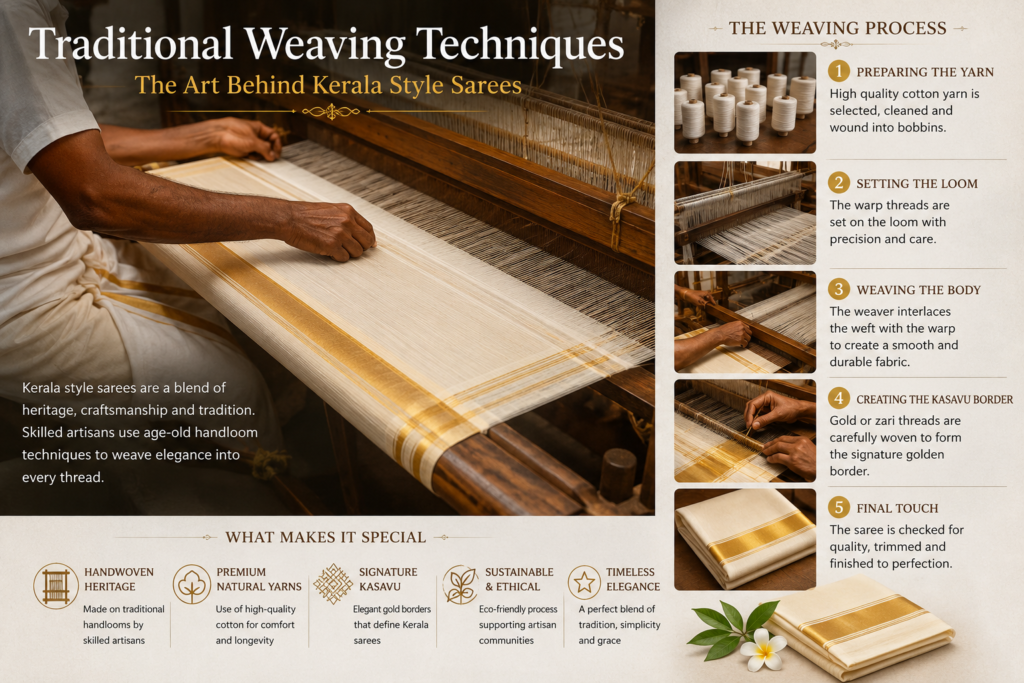
At the heart of every authentic Kerala style saree is the traditional handloom. Before any weaving begins, artisans carefully prepare the loom by arranging hundreds of warp threads in perfect alignment. This setup requires remarkable attention to detail because even a slight misalignment can affect the final design and texture of the saree.
Once the loom is prepared, the weaver interlaces the weft threads by hand, creating a tightly woven fabric that is lightweight, breathable, and durable. Unlike automated weaving machines, handlooms allow artisans to control every movement, resulting in a fabric that feels soft yet maintains excellent strength.
Each saree takes several days to complete, depending on the complexity of the border, motifs, and weaving pattern. This slow and meticulous process ensures that every Kerala saree is unique and crafted with exceptional care.
Selecting the Finest Yarn
The quality of a Kerala style saree begins with choosing the right yarn. Traditional weavers carefully inspect cotton fibers to ensure they are smooth, strong, and suitable for producing fine fabrics.
High-quality cotton is spun into uniform threads before being prepared for weaving. The strength and consistency of these threads directly influence the durability and comfort of the finished saree. Since Kerala experiences a warm and humid climate, lightweight cotton has always been the preferred choice because it allows air to circulate freely while remaining comfortable throughout the day.
Modern handloom centers also produce cotton-silk blends, but many artisans continue to prioritize pure cotton for its authenticity and timeless appeal.
Preparing the Threads Before Weaving
Before weaving can begin, the yarn undergoes several preparation stages. The threads are cleaned, stretched, and carefully arranged to prevent tangling during the weaving process.
Traditional artisans often apply natural starch to strengthen the threads, making them easier to handle on the loom. This preparation improves the weaving efficiency while helping maintain the fabric’s smooth texture.
Although these steps may seem simple, they require years of experience to execute correctly. Proper thread preparation contributes significantly to the saree’s longevity and refined finish.
Creating the Signature Kasavu Border
One of the most recognizable features of a Kerala style saree is its elegant Kasavu border. Weaving this border requires a completely different level of craftsmanship compared to weaving the body of the saree.
Traditionally, artisans incorporated gold-coated silver threads into the border by hand, creating a subtle yet luxurious appearance. Today, many sarees use premium zari threads that replicate the classic golden finish while making the sarees more accessible.
The border is woven simultaneously with the main fabric rather than being attached afterward. This integrated weaving technique ensures the border remains durable, perfectly aligned, and seamlessly connected to the saree.
The width and design of the Kasavu border may vary, but the weaving precision required remains remarkably consistent across every authentic Kerala saree.
Maintaining Uniformity Throughout the Saree
Achieving a consistent weave is one of the greatest challenges in traditional handloom weaving. Throughout the weaving process, artisans continuously monitor thread tension, spacing, and alignment to ensure that the fabric remains even from beginning to end.
This careful supervision prevents irregularities such as loose threads, uneven borders, or distorted patterns. Maintaining this level of consistency demands both technical expertise and years of practical experience.
The result is a saree with a smooth finish, balanced texture, and elegant drape that machine-made fabrics often struggle to replicate.
The Role of Skilled Artisan Communities
Traditional weaving techniques have survived largely because of Kerala’s dedicated artisan communities. For generations, weaving knowledge has been passed down within families, allowing younger artisans to learn directly from experienced craftsmen.
These communities preserve not only technical skills but also cultural values associated with textile production. Every stage of weaving—from setting up the loom to completing the final border—is performed using methods that have remained largely unchanged for centuries.
Many cooperative weaving societies continue to support local artisans by promoting handcrafted Kerala sarees while ensuring traditional techniques remain economically sustainable.
Precision Through Experience
Unlike automated production, traditional weaving depends almost entirely on human expertise. Experienced weavers can identify small imperfections immediately and make adjustments while the saree is still on the loom.
This ability comes only after years of practice. The rhythm of handloom weaving, the control of thread tension, and the accuracy required to create flawless borders cannot be mastered overnight.
Each finished Kerala style saree therefore represents not just craftsmanship but also decades of accumulated knowledge and experience.
Blending Heritage with Modern Innovation
While traditional weaving methods remain the foundation of Kerala sarees, artisans have gradually introduced modern innovations without compromising authenticity. Improved handlooms, better-quality yarns, and environmentally friendly production methods have enhanced efficiency while preserving the handmade character of the saree.
Designers also collaborate with traditional weavers to introduce contemporary color combinations, minimalist patterns, and lightweight fabrics that appeal to younger generations. Despite these innovations, the essential weaving techniques continue to follow age-old traditions.
This balance between heritage and innovation has allowed Kerala style sarees to remain relevant in today’s fashion landscape while honoring their historical roots.
Why Traditional Weaving Still Matters
In an era dominated by machine-made textiles, traditional weaving continues to represent quality, authenticity, and sustainability. Handwoven Kerala style sarees are valued not only for their beauty but also for the human skill invested in every piece.
Choosing a traditionally woven saree supports local artisan communities, preserves cultural heritage, and encourages sustainable fashion practices. Each purchase contributes to keeping centuries-old weaving traditions alive for future generations.
Conclusion
The traditional weaving techniques behind a Kerala style saree are a remarkable combination of artistry, patience, and technical expertise. From selecting premium cotton yarn and preparing the loom to weaving the signature Kasavu border, every step reflects a commitment to excellence that has been preserved for generations.
These timeless techniques continue to distinguish authentic Kerala sarees from mass-produced alternatives, making them symbols of elegance, craftsmanship, and cultural heritage. As fashion continues to evolve, the enduring value of traditional weaving reminds us that true beauty often lies in the skill, dedication, and history woven into every thread.